Thought Park app icon

Thought Park

A private focus tool for recurring thoughts

Give the thought a place to wait—not the whole day.

Thought Park helps you capture what is stuck, separate what happened from what you are imagining, decide whether one useful action exists, and schedule a deliberate time to revisit the rest.

Use Thought Park nowNo account required
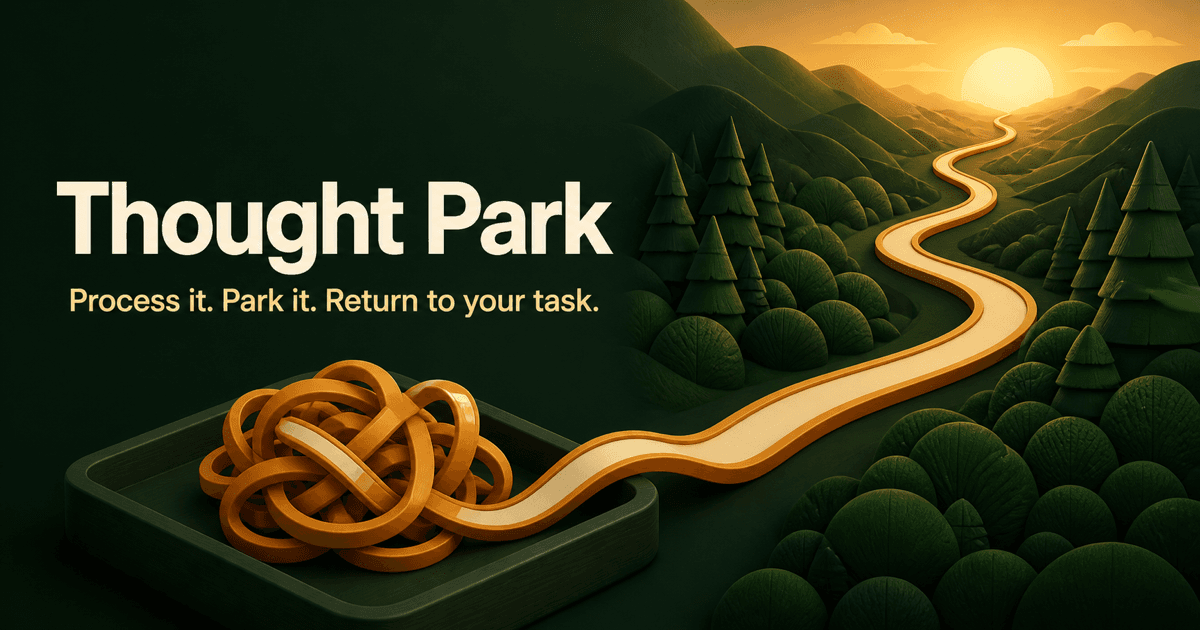
A tangled amber path becoming clear through a green park

When it can help

For thoughts that feel urgent even when nothing new can be done

Thought Park is useful when attention keeps returning to a topic after you have already extracted the available information. It provides a boundary around reflection without asking you to dismiss the concern.

Rumination and replaying

When your mind keeps reviewing the same conversation, mistake, decision, or imagined outcome without producing useful new information.

Waiting and uncertainty

When a reply, result, decision, or future event is outside your control but continues to demand your attention.

Limerence-style loops

When attention repeatedly returns to a person, message, possibility, or search for reassurance. Thought Park can structure the pause, but it does not diagnose or treat limerence.

Work and unfinished decisions

When an unresolved task matters, but there is no useful move to make until more information or a better time arrives.

The complete flow

From mental loop to a clear next boundary

01

Capture the thought

Write enough to recognize what is pulling at your attention. The goal is a clear record, not a perfect explanation.

02

Separate fact from interpretation

Record what actually happened, then name the assumptions, predictions, or meanings your mind is adding.

03

Notice the pull

For relationship-focused thoughts, identify the tempting behavior—checking, rereading, analyzing, contacting, or asking for reassurance—and whether it would add information or fuel the loop.

04

Choose one useful action

If something can genuinely help, name exactly one next action. If nothing useful can be done now, let that be the decision.

05

Set a revisit time

Choose thirty minutes, tonight, tomorrow, or a custom time. The thought is not being denied; it has a deliberate place on your schedule.

06

Return to the present task

Name what you are returning to. If the thought resurfaces early, Thought Park asks whether anything new actually happened before reopening it.

07

Resolve, archive, or return

When the loop is finished, mark it resolved or archive it. Past entries remain available from the app home screen and can be parked again if the situation changes.

Why parking is different

Contain the loop without dismissing the concern

Capture, not suppression

The thought is recorded with its facts, interpretation, and next action. You are not required to pretend it does not matter.

Postpone with intention

A revisit time turns an indefinite mental demand into a bounded commitment. This is structured postponement, not permanent avoidance.

Reopen only for a reason

Before the scheduled time, the app checks for genuinely new information. Nothing new means there is nothing new to solve.

Private by default

Start locally. Sync only when you choose.

Without an account, entries stay in this browser. This makes it possible to begin immediately without providing an email address.

If you sign in, your entries are stored in your private account and synchronized across devices. Access controls keep each account limited to its own Thought Park data.

A local copy remains available during temporary connection problems, and sync can resume when the cloud is reachable.

Permanently deleting an entry removes its thought content and redirect history. A non-content deletion marker—entry ID, account ID, and deletion time—is retained so an older offline device cannot restore it later.

Open the private web app

Questions

A few important distinctions

Is Thought Park a compartmentalization tool?

Not in the sense of denying or sealing off an emotion. Thought Park is designed for deliberate containment: record what matters, decide what is actionable, choose when to revisit it, and free your attention until then.

Can I use it for limerence?

It may help organize limerence-style thought loops, reassurance seeking, checking urges, and repeated interpretation. It is a focus tool, not a clinical assessment or treatment for limerence or any mental-health condition.

Do I need an account?

No. You can use Thought Park privately in the current browser. Signing in is optional and makes your entries available across your devices through private account-backed sync.

What happens when the thought comes back early?

The app asks whether anything new actually happened. If not, it records a successful redirect and reminds you what you intended to return to. If new information arrived, you can add it and reconsider the entry.

Where are resolved and archived entries?

Open Past entries on the Thought Park home screen, then filter by All, Resolved, or Archived. Each entry opens into its full detail view, where you can park it again, change its status, or permanently delete it.

When the thought keeps returning

Capture it once. Decide what is useful. Give the rest a time and place.

Thought Park is a focus and reflection tool. It is not therapy, medical care, crisis support, or a substitute for professional help.

Use Thought Park